

A parent’s guide to talking to adult children about money: custodial accounts, first paychecks and the questions that follow.
- Starting early changes the math — compounding favors the first dollars in
- A plan should help young adults stand on their own, not wait on an inheritance
- You can communicate there is a plan, and that there is care behind it, without naming a dollar figure
September has a way of showing parents that the money lessons they gave their small children did their job, and bigger conversations lie ahead. One kid comes home from a summer grand tour of Europe, a little sheepish about how fast the euros disappeared, and wondering what will fund pocket money for senior year at college. Another opens his first post-college paycheck and has no idea what “gross” versus “net” means. For a lot of parents, that is the moment the next conversation announces itself.
A decade ago, apps started putting debit cards and investing tools in children’s hands — training wheels for money, built to eventually come off. Now that generation is turning 22, 23, 25. The wheels are gone.
At Gryphon Wealth, that persistent parental worry — does my kid actually know how to handle money? — lands on our advisors’ desks as real conversations with clients’ 20-something children and grandchildren. Some adult children are taking over custodial accounts — investment accounts a parent opened years ago that legally become theirs at adulthood. Others are opening their first 401(k). A few are stepping into family wealth they don’t yet fully understand. Here are three things we tell clients to say to the 20-somethings in their lives.
1. Invest for the Long Haul, not the Moment – the difference between investing and speculating
The starting point is the difference between investing and speculating. Keep the core of what a young adult owns broad and boring, and cap anything speculative at an amount they could lose entirely without it changing their life.
One question comes up again and again with clients’ 23- to 25-year-olds taking over accounts their parents set up: should I move this into a trading app and pick stocks myself, or invest the way Mom or Dad do?
Framed that way, it sounds like a binary choice. It isn’t. The real answer lives in the middle — starting with the difference between investing and speculating. If a 20-something wants to try picking individual stocks or trading on a hot tip, that’s fine, as long as they treat it like a trip to the casino: money they’re prepared to lose, kept small enough that a total wipeout wouldn’t change their life. The core of what they own should stay boring and broad.
Why boring and broad? Because of compounding, the growth that a young adult’s earnings go on to earn. The doubles that happen right before retirement are the biggest ones because there’s more money to double by then — which is why starting early can beat saving more later. The classic illustration: a 20-something who invests for just seven years and then stops can end up ahead of someone who waits seven years and invests for decades afterward, purely because those early dollars have had more time to compound.
Boring, Brilliant Compounding
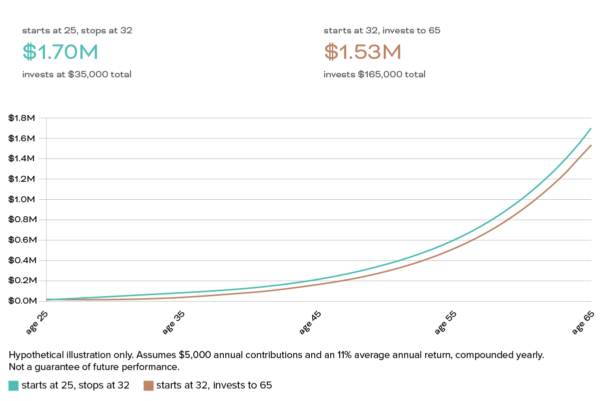
Starting early only works, though, if the early moves are the right ones. A young adult should capture any employer 401(k) match in full — it’s free money — and then act aggressively with the rest. A common approach: split contributions between a broad S&P 500 fund and a Nasdaq fund and try to avoid overthinking it, since that money can’t be touched for decades. An emergency fund comes next. And the mindset that ties it together is what one Gryphon Wealth partner calls “paying yourself last.” Set a savings target that feels almost too hard: 25% of every paycheck, if possible. Bank half of every future raise instead of upgrading your lifestyle to match salary bumps.
A recent Bloomberg article calls the young investors who do this “retirement maxxers,” and describes 20-somethings with a clear focus on financial independence and net worths approaching six figures.1 One 20-something super saver we know followed this approach and even became a regular caller when she had an extra couple thousand dollars and no idea where to put it. By her early 30s she’d funded a retirement plan, a Roth IRA a taxable account, an emergency fund, and her first house — ahead of most peers.
2. Don’t Wait on an Inheritance From Us
The conversations that come up most with 20-somethings aren’t about inheritance at all. They’re the fundamentals: paying for the rest of college, understanding taxes once a paycheck starts arriving and building a plan that stands on its own.
Across Gryphon Wealth’s next-generation households, the conversations that come up most with 20-somethings aren’t about inheritance. They’re the fundamentals: funding the rest of college, understanding taxes once a paycheck starts arriving, and building a financial plan that lets a young adult stand on their own two feet — rather than plan around money that may or may not show up.
That instinct matters more than ever. A 2024 Pew Research Center study, Financial Help and Independence in Young Adulthood, found a rising share of parents are already sending recurring financial support to grown children well into their 30s,2 which makes the discipline of independent footing even more valuable to instill early. One useful mental model: tell your kids that you’re financially comfortable or rich, if that’s the case, but that they are not — yet. Warren Buffett has said for years, and reiterated in a 2025 letter about his own estate plans, that wealthy parents should leave children “enough to do anything, but not enough to do nothing.”3 The goal is freedom of choice, not a substitute for ambition.
3. We Have a Plan, But We’re Not Ready to Talk Price Tag
For most families, the right amount to disclose to a 20- or 25-year-old is that a plan exists and there is care behind it, not the dollar figure. If this feels wrong, picture telling your 25-year-old that they stand to inherit $8 million or $15 million at a certain age and what that might do to their career, relationship, and spending choices.
Knowing that doesn’t make the conversation easier to start. Money talks can be awkward, anxiety-ridden, and easy to postpone. That’s why the message tends to land better coming through a relationship than through a script. A parent’s trust in our firm often becomes a head start with their adult children, long before we’ve met them.
It’s part of why Gryphon Wealth treats next-generation households as an extension of the family relationship: households may qualify for the same family pricing their parents receive, depending on the household’s circumstances. Sometimes our work with adult children starts small — a 15-minute call with no agenda, just to help a 20-something understand the custodial account that’s about to become theirs, or to walk through what to do with a first 401(k) enrollment form. Whether it’s the first step or a bigger conversation, reach out to Gryphon Wealth to get started.
Frequently Asked Questions
- At what age does a custodial account become my child’s?
A custodial account is an investment account a parent opens for a minor that legally transfers to the child at the age of majority, commonly 18 or 21 depending on the state and the account type. Once it transfers, the money is theirs to direct. - How much should a 20-something save from each paycheck?
Capture any employer 401(k) match in full first, since that is money left on the table otherwise. Beyond that, an ambitious target is 25% of every paycheck, and banking half of every future raise rather than raising your spending to match. - Should I tell my adult children how much they will inherit?
For most families, no, not yet. Telling a 20-something there is a plan, and that thought and care went into it, gives them the reassurance without the number. A specific figure at 25 can quietly reshape career, relationship and spending decisions. - What should a young adult do with a first 401(k) enrollment form?
Contribute at least enough to capture the full employer match, then choose a low-cost, broadly diversified option appropriate to a decades-long time horizon. What’s right depends on the individual’s situation, and a short conversation with an advisor is often enough to settle it. - What’s the difference between investing and speculating?
Investing means owning a broad, diversified mix for a long period. Speculating means betting on a specific outcome — an individual stock, a tip, a trend. Speculating isn’t off-limits for a young adult, but it should be capped at an amount they could lose entirely without it changing their life.
Sources
- These Gen Z Investors Found the Cheat Code to Long-Term Wealth (Bloomberg)
- Financial Help and Independence in Young Adulthood (Pew Research)
- Berkshire Hathaway News Release Nov. 10, 2025
Disclosures
Gryphon Wealth, LLC is an investment adviser registered under the Investment Advisers Act of 1940. Registration as an investment adviser does not imply any level of skill or training. For more information, visit adviserinfo.sec.gov and search for our firm name.
This material is presented solely for informational purposes and has been gathered from sources believed to be reliable; however, the adviser cannot guarantee the accuracy or completeness of such information. Nothing in this presentation is intended to serve as personalized investment, tax, or insurance advice. Advisory services are only offered to clients or prospective clients where the adviser and its representatives are properly licensed or exempt from licensure.
Opinions expressed are based on economic or market conditions at the time this material was written. Economies and markets fluctuate. Actual economic or market events may turn out differently than anticipated. Any opinions expressed are current only as of the time made and are subject to change without notice.
Investing involves risk, including the possible loss of principal. Diversification does not ensure a profit or protect against loss.
Any growth illustration shown is hypothetical, is provided for educational purposes only, does not represent any actual investment, and does not reflect the effect of fees or taxes.
This article references tax treatment of retirement accounts. It is not tax advice. Please consult your tax advisor regarding your specific situation.
Client examples described in this article are included for illustration. They are not testimonials, do not describe investment performance, and should not be taken as representative of any other client’s experience.
Past performance is not indicative of future results. This article was created with the assistance of artificial intelligence as part of the research and drafting process.